
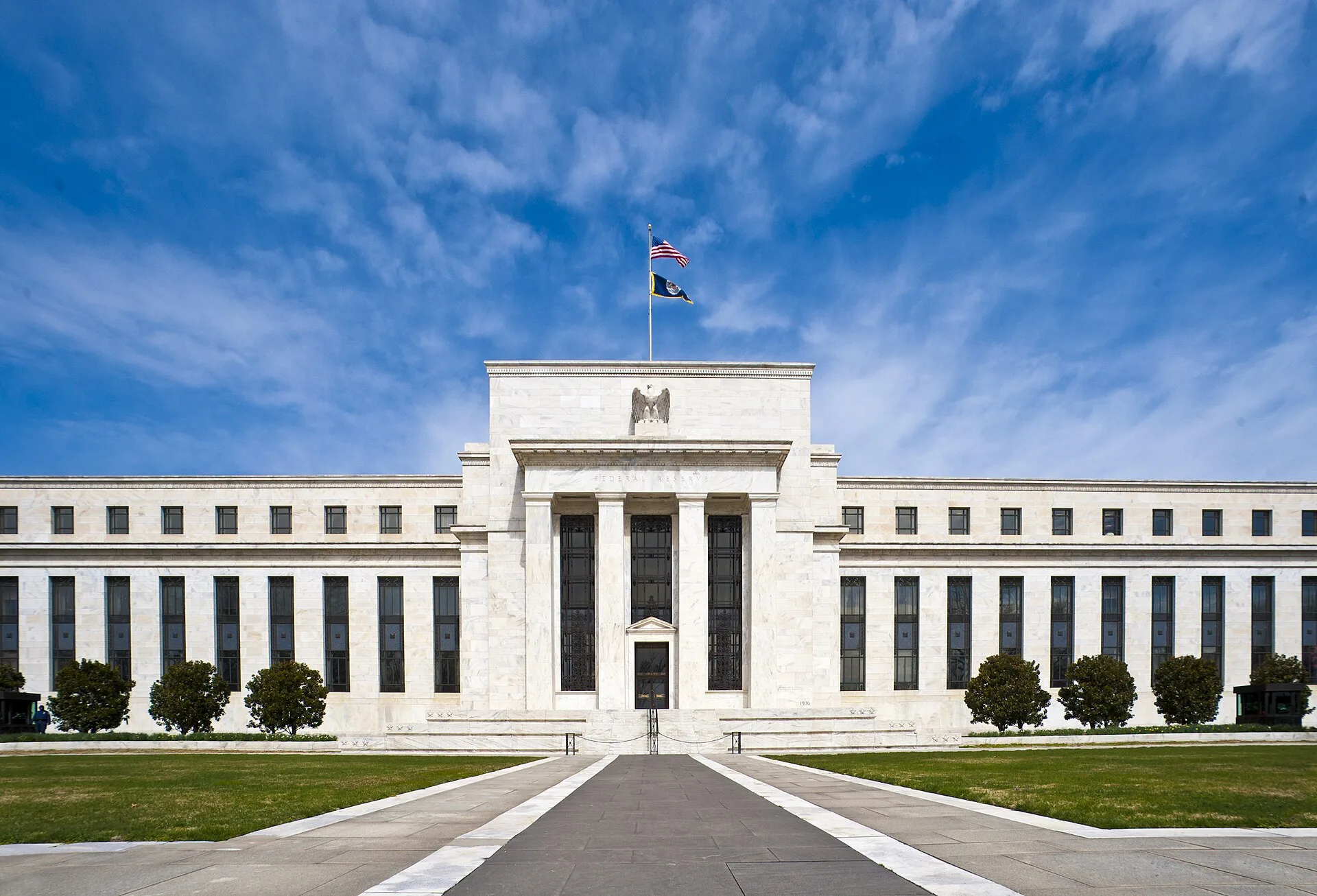
Will the Fed raise interest rates again? Most coverage of Wednesday’s hike treats the answer as a single year-end probability, and that framing hides the part that matters to anyone running rate risk. There are only two decisions left in 2026, on 28 October and 9 December, and each one lands a day before an inflation report the Committee would want in hand. October gets September CPI but not September PCE; December gets October PCE but not November CPI. The Bureau of Economic Analysis schedule puts September PCE on 29 October, and the Bureau of Labor Statistics calendar puts November CPI on 10 December. On our read of Polymarket at 07:42 UTC on 17 September, a 25bp-or-larger October hike traded at 45%. December traded at 70%. The Federal Reserve lifted its target range to 3.75%-4.00% on a 12-0 vote on 16 September, its first increase since 2023.
The venues do not agree, and the disagreement runs in one direction. Rebuilding the FedWatch method by hand from CBOT 30-day fed funds futures, because CME’s own tool blocked us, gives 50% for October and 79% for December. That puts futures 3 to 9 points more hawkish than the prediction markets at every meeting. Polymarket also contradicts itself: its per-meeting contracts imply a 34% chance of hikes at both meetings, while its own hike-count market prices three or more 2026 hikes at 16%.
Key facts
- Fed funds target range raised 25bp to 3.75%-4.00%, vote 12-0 — Federal Reserve, 16 Sep 2026
- Remaining 2026 FOMC meetings: 27-28 October and 8-9 December; next is 26-27 January 2027 — Federal Reserve calendar, updated 16 Sep 2026
- October hike odds 45% on Polymarket, 47% on Kalshi; December 70% and 72% — Polymarket and Kalshi APIs, 17 Sep 2026 07:42 UTC
- Fed funds futures imply roughly 50% for October and 79% for December — FinanceFeeds calculation from CBOT settlements, 16 Sep 2026
- August CPI rose 0.4% on the month and 3.4% on the year — BLS, released 11 Sep 2026
- Polymarket’s “Another Fed rate hike in 2026?” contract trades at 81% Yes — Polymarket, 17 Sep 2026
- Nonfarm payrolls rose 162,000 in August; unemployment held at 4.1% — BLS, released 4 Sep 2026
When is the next Fed meeting, and what is priced for it?
The next Fed meeting runs 27-28 October, with the statement customarily released at 2:00 p.m. ET on the Wednesday. After that the Committee meets 8-9 December, a meeting that carries a new Summary of Economic Projections, and then 26-27 January 2027. The Fed’s calendar page adds a caveat most rate desks ignore: each date is tentative until confirmed at the meeting before it.
Pricing for October is close to a coin flip. On Polymarket, the “No change” outcome traded at 54.5% and “25 bps increase” at 44.5%, with a further 0.75% on 50bp or more. The October event has taken $5.0 million in volume, the deepest of the three. Kalshi’s KXFEDDECISION-26OCT market showed a 45-46 cent bid-ask on a 25bp hike and 55-57 cents on a hold. December flips the balance. Polymarket had a 25bp December increase at 68.5%, Kalshi at 69-70 cents, and both put a hold near 30%.
January is where liquidity thins out. Polymarket’s January contract has drawn $84,000 of volume against $5.0 million for October, and Kalshi’s January 25bp hike quote was 22 cents bid, 54 cents offered, with a last trade at 29 cents. Treat any single January number as indicative only.
How did the Fed get here? At the July meeting the Committee held at 3.50%-3.75% on a 9-3 vote, with Beth Hammack, Neel Kashkari and Lorie Logan dissenting in favour of a hike, according to the 29 July statement. Seven weeks later the dissenters had the whole room. The September statement dropped July’s language tying inflation to energy supply shocks and said simply that inflation “remains elevated.”
Chairman Kevin Warsh used his opening remarks to set a bar for the next move rather than a date. He cited a likely 3.6% August reading for total PCE and noted that too many categories are still rising above 3% on both a six- and twelve-month basis. He also read out the SEP median of 4.1% for the funds rate at year-end, one more quarter-point move from here.
“Last month in Wyoming, I expressed my commitment to a monetary policy discipline, not to a decision. I defined the standard for action: We must be confident that underlying inflation is moving to our objective, clearly and at sufficient speed,” Kevin Warsh, Chairman at the Federal Reserve, said in his 16 September press conference opening statement. “Today, the FOMC decided that this standard has not been satisfied.”
Which banks call October, and which call December?
Among strategists who named a meeting within hours of the decision, December beat October by two to one. A reaction survey compiled by Reuters and Globe staff and published by The Globe and Mail on 16 September collected the views below; we sorted them by the meeting each firm named.
| Firm | Next hike called for | Stated condition or reason |
|---|---|---|
| National Bank of Canada | October | Sees a 4.25% upper bound as the likely peak |
| CIBC | October | Oil above $100 a barrel risks spillover into core |
| Capital Economics | December | Also forecasts a third hike in 2027 |
| Goldman Sachs Asset Management | December | October too close to the midterm elections |
| Monex | December | Contingent on more evidence of inflation pressure |
| Natixis | December | Flags the risk that September is “one and done” |
| Annex Wealth Management | No further hike assumed | Compares the move with the single 1997 hike |
The October camp leans on momentum. “We do believe that further tightening is in store, likely at the next decision in late October,” wrote Taylor Schleich and Ethan Currie, economists at National Bank of Canada. Helen Lao, economist at CIBC, went further: “Our forecast has the Fed hiking by another 25bps in October, in line with the median dot of one more hike by the end of the year.”
The December camp leans on the calendar. Kay Haigh at Goldman Sachs Asset Management argued October falls too close to the 3 November midterms, and Christopher Hodge, chief US economist at Natixis, penciled in December while conceding the first hike “could be one and done.” Brian Jacobsen, chief economist at Annex Wealth Management, framed it as a choice between 1994 and 1997, and said he “wouldn’t bank on another hike this year.”
For brokers and market makers pricing SOFR options or short-dated Treasury products into year-end, the practical read is that the Street’s median call lines up with the prediction markets’ 70% for December. The minority October call is the one that futures, at 50%, are paying up for. The October bet rests on the bar Warsh set in his Jackson Hole speech in late August, which he restated on Wednesday almost word for word.
“One more hike this year in December is our base case, although this remains contingent on upcoming CPI reports and the path of energy prices,” said Kay Haigh, Global Head and CIO of Fixed Income and Liquidity Solutions at Goldman Sachs Asset Management.
Next Fed rate hike odds: three venues, three answers
The chart below sets the three pricing sources side by side for each remaining meeting. Prediction-market figures are the combined price of the 25bp and 50bp-plus hike outcomes.
| Meeting | Polymarket | Kalshi | Fed funds futures (FF calc) | Futures minus Polymarket |
|---|---|---|---|---|
| 27-28 Oct 2026 | 45% | 47% | 50% | +5 pts |
| 8-9 Dec 2026 | 70% | 72% | 79% | +9 pts |
| 26-27 Jan 2027 | 33% | 31% (last trade) | 37% | +4 pts |
CME’s FedWatch page and quote service returned a scraping block to our requests, so the futures column is our own arithmetic. The method mirrors FedWatch. The New York Fed printed the effective fed funds rate at 3.63% on 15 September, 13bp above the old 3.50% floor, so we assume 3.88% after the hike. The September contract settled at 96.255 on 16 September, implying a 3.745% monthly average. Our model gives 3.747%, which suggests the assumption holds. November (95.995, no meeting in the month) then implies about 50% for October. December’s 95.855, with 22 of 31 days after the 9 December decision, implies 79%. February’s 95.705 against the post-December path implies 37% for January. Settlement prices came from CNBC’s quote service.
Two caveats. Futures embed a small term premium and fold cut risk into the same number, which inflates hike odds a little. Prediction markets can also run light on institutional flow. Polymarket’s December event has traded $970,000 in total, while the CBOT December fed funds future carried open interest of 218,948 contracts on 16 September, each with a $5 million notional.
The more useful finding is inside each venue. Polymarket’s October and December contracts, combined with its 81% “another hike in 2026” price, imply a 34% chance of hikes at both meetings. Its separate count market prices three, four or five-plus hikes for the year, which is what October-plus-December would mean, at 16.3%. Kalshi shows the same gap, smaller: 36.5% implied from its per-meeting contracts, 29% on its December rate ladder (above 4.25%), and about 22% in its hike-count market. Per-meeting contracts attract most of the volume, and in both venues they lean more hawkish than the aggregate markets. We covered a similar split between Polymarket and FedWatch ahead of the September decision, when futures again ran ahead.
“Looking ahead, inflation would likely have to slow more quickly than expected for the Fed not to raise rates again,” said Steve Sosnick, Chief Strategist at Interactive Brokers.
The data calendar, the midterms and the 2023 precedent
The structural problem for the Committee is timing. Between now and 28 October, the releases that can move the October call are August PCE on 30 September, September payrolls on 2 October and September CPI on 14 October. September PCE and the advance estimate of third-quarter GDP arrive on 29 October, the morning after the decision.
| Date (2026) | Release | Agency | Relevant meeting |
|---|---|---|---|
| 30 Sep | Personal Income and Outlays, August (PCE) | BEA | October |
| 2 Oct | Employment Situation, September | BLS | October |
| 14 Oct | CPI, September | BLS | October |
| 29 Oct | PCE, September; GDP Q3 advance | BEA | December (day after October decision) |
| 6 Nov | Employment Situation, October | BLS | December |
| 10 Nov | CPI, October | BLS | December |
| 25 Nov | PCE, October | BEA | December |
| 4 Dec | Employment Situation, November | BLS | December |
| 10 Dec | CPI, November | BLS | January (day after December decision) |
That leaves the 14 October CPI as the single print carrying the most weight. It is the only CPI report inside the October window, and a strong core number would also arrive before the Fed sees September PCE. Seasonally adjusted core CPI rose 0.3% in August after 0.2% in July, on BLS index data, as our report on the August CPI noted at the time. A repeat at 0.3% gives the October hawks their case.
Politics adds a second constraint. The Reuters copy in that survey notes Warsh was selected by President Trump “with an expectation that he would cut rates,” and the October meeting ends six days before the 3 November midterm elections. Nothing on the Fed’s published calendar pauses policy around an election, yet Goldman Sachs Asset Management’s call treats the proximity as a reason to wait.
Then there is the precedent. In the September 2023 projections, 12 of 19 participants put the year-end midpoint at 5.625%, one hike above the 5.25%-5.50% range. The hike never came. The Fed held in December 2023 and next moved with a 50bp cut in September 2024. The language then sounded as firm as today’s.
“We’re prepared to raise rates further if appropriate, and we intend to hold policy at a restrictive level until we’re confident that inflation is moving down sustainably toward our objective,” Jerome Powell, then Chair of the Federal Reserve, said at the 20 September 2023 press conference.
What happens next: three calls with dates
1. The October price stays pinned near 50% until 14 October. With no CPI between now and then, the payrolls report on 2 October is the only scheduled catalyst big enough to move it. A core CPI print of 0.3% or more on 14 October should push Polymarket’s October contract above 60%, because it would repeat August’s pace in the one CPI report the Committee sees before voting. A 0.1% or 0.2% print does the reverse and pushes the probability mass to December.
2. The futures-versus-prediction-market gap narrows by December, from the prediction-market side. The internal inconsistency on Polymarket, 34% implied against 16% in the count market, is the kind of spread arbitrage desks close once volume arrives. The per-meeting markets hold most of the money, so the count market is the likelier one to reprice upward.
3. December is decided without November CPI. Because that report lands on 10 December, the Committee will lean on October CPI (10 November), October PCE (25 November) and November payrolls (4 December). If those three run hot, a second hike looks likely; if they soften, 2023’s unrealised “one more hike” is the template. Either way, the 10 December CPI sets the pricing for 27 January 2027.
The payoff asymmetry is easy to read off the count market. A single further hike at either meeting resolves Polymarket’s “2 (50 bps)” outcome, priced at 67 cents, and returns about 49%. Hikes at both meetings resolve “3 (75 bps)”, priced at 14.3 cents, at roughly seven times the stake. Anyone who trusts the per-meeting contracts’ 34% joint probability sees that second outcome as cheap. Anyone who trusts the count market sees the per-meeting contracts as rich. One of the two will be wrong by 9 December.
FAQ
Will the Fed raise interest rates again in 2026?
Markets think so, but not with certainty. Polymarket’s “Another Fed rate hike in 2026?” contract traded at 81% Yes on 17 September 2026. The Fed has two meetings left, 27-28 October and 8-9 December. December carries higher odds, about 70% on Polymarket and 72% on Kalshi, than October at 45% and 47%.
When is the next Fed meeting?
The next FOMC meeting is 27-28 October 2026, with the policy statement customarily released at 2:00 p.m. ET on the second day, 28 October. The final 2026 meeting is 8-9 December and includes updated economic projections. The first 2027 meeting is 26-27 January, according to the Federal Reserve’s calendar.
What are the odds of a Fed rate hike in October 2026?
Roughly even. On 17 September 2026 Polymarket priced a 25bp-or-larger October hike at 45% and Kalshi at 47%. A FinanceFeeds calculation from CBOT 30-day fed funds futures settlements implies about 50%. CME FedWatch was not reachable for this article, so its figure is not included.
Which data release matters most for the next Fed rate hike?
September CPI, due 14 October 2026 at 8:30 a.m. ET, is the only CPI report before the October decision. September PCE, the Fed’s preferred inflation gauge, is not released until 29 October, the day after the meeting. For December, November CPI arrives on 10 December, one day after that decision.
What interest rate did the Fed set in September 2026?
The FOMC raised the federal funds target range by 25 basis points to 3.75%-4.00% on 16 September 2026, in a unanimous 12-0 vote. It was the Fed’s first rate increase since July 2023, when the range reached 5.25%-5.50%, and followed a 9-3 hold in July 2026.