
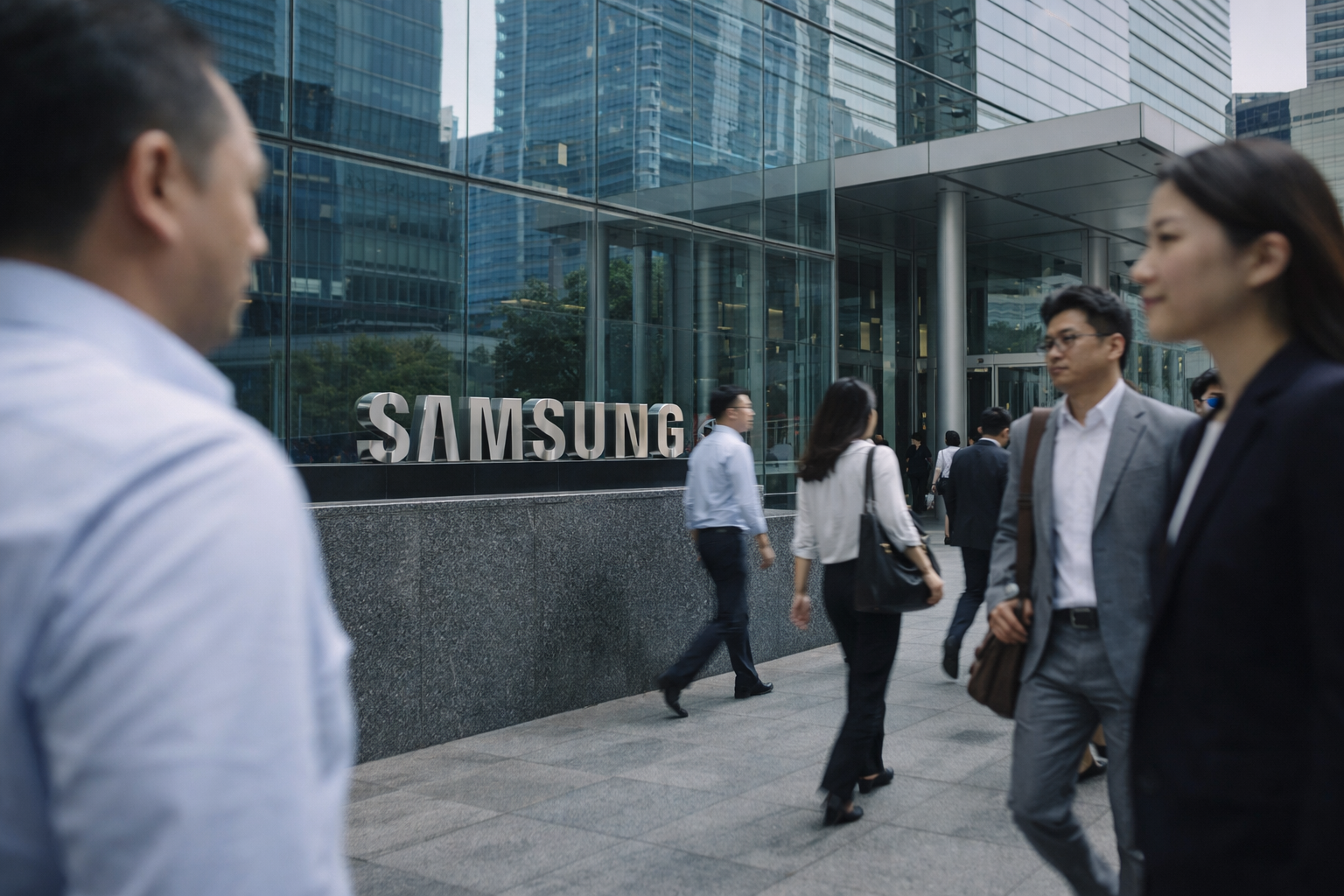
Samsung Electronics stock rebounded on Tuesday after a 5.4% rout, as investors weighed a $1 billion AI infrastructure commitment that pushes the group’s strategy beyond memory chips.
The company and five affiliates will invest in Helix Digital Infrastructure, a KKR-led, Nvidia-backed platform developing data centres, power systems and connectivity for AI.
Samsung Electronics will contribute $500 million, with Samsung C&T, Samsung SDS, Samsung SDI, Samsung Life and Samsung Fire & Marine providing the remaining $500 million.
The deal broadens Samsung’s AI exposure as its HBM business gains momentum.
Samsung wants a bigger share of the AI stack
Helix changes the narrative because it is not simply another semiconductor bet.
The platform is focused on hyperscale data centres, power generation and transmission, fibre networks and infrastructure. Helix expects to combine Nvidia technology with Samsung’s capabilities across technology, construction and energy systems.
That gives the Samsung group exposure to more AI spending.
Samsung Electronics can provide semiconductors, Samsung SDS brings cloud expertise, Samsung SDI adds energy-storage capabilities, while Samsung C&T has construction and engineering experience.
KB Securities research head Kim Dong-won has argued Samsung has a rare semiconductor advantage.
“It is the only company that has secured the capability to provide turnkey solutions encompassing HBM, foundry, and packaging,” Kim said in a report quoted by Edaily this month.
Helix extends that one-stop-shop idea beyond the chip into the infrastructure surrounding AI computing.
Memory remains the engine behind the shares
The broader strategy does not make memory less important to Samsung’s earnings.
Samsung Executive Vice President Kim Taewoo said Tuesday that HBM could account for nearly 30% of global DRAM wafer capacity next year, up from about 20%.
Because HBM and conventional DRAM compete for the same wafer capacity, greater HBM production can tighten supply of standard memory.
That supports pricing in Samsung’s semiconductor business.
Yuanta Securities Korea analyst Baek Gil-hyun recently raised his Samsung target to 630,000 won, arguing that the memory shortage could last longer than investors expect.
“Supply constraints are likely to ease later than expected,” Baek said in comments reported by Seoul Economic Daily.
His view is that HBM is consuming capacity that would otherwise produce conventional DRAM, while AI inference is increasing demand for higher-capacity memory. Yuanta expects tight conditions to persist through 2028.
Helix broadens Samsung’s strategic story, but memory remains the cash-generating engine that gives the group room to finance expansion elsewhere.
The real test is whether Samsung can monetise its breadth
The market already knows Samsung is exposed to AI. What remains unproven is whether its sprawling portfolio can generate more value together than separately.
That question became sharper after Monday’s selloff. Samsung closed at 270,000 won, down 5.43%, as foreign and institutional selling hit Korean technology shares amid higher global bond yields.
J.P. Morgan analysts led by Mislav Matejka said this week that the broader AI trade could recover after the recent pullback, arguing that positioning had become cleaner and valuations more attractive.
“The fundamental case is constructive and there are plenty of opportunities within the AI complex,” the analysts said in comments reported by Reuters.
The shift changes the debate for Samsung, as investors no longer need convincing that AI spending exists.
They need evidence Samsung can capture that spending across several businesses without simply adding capital commitments.