
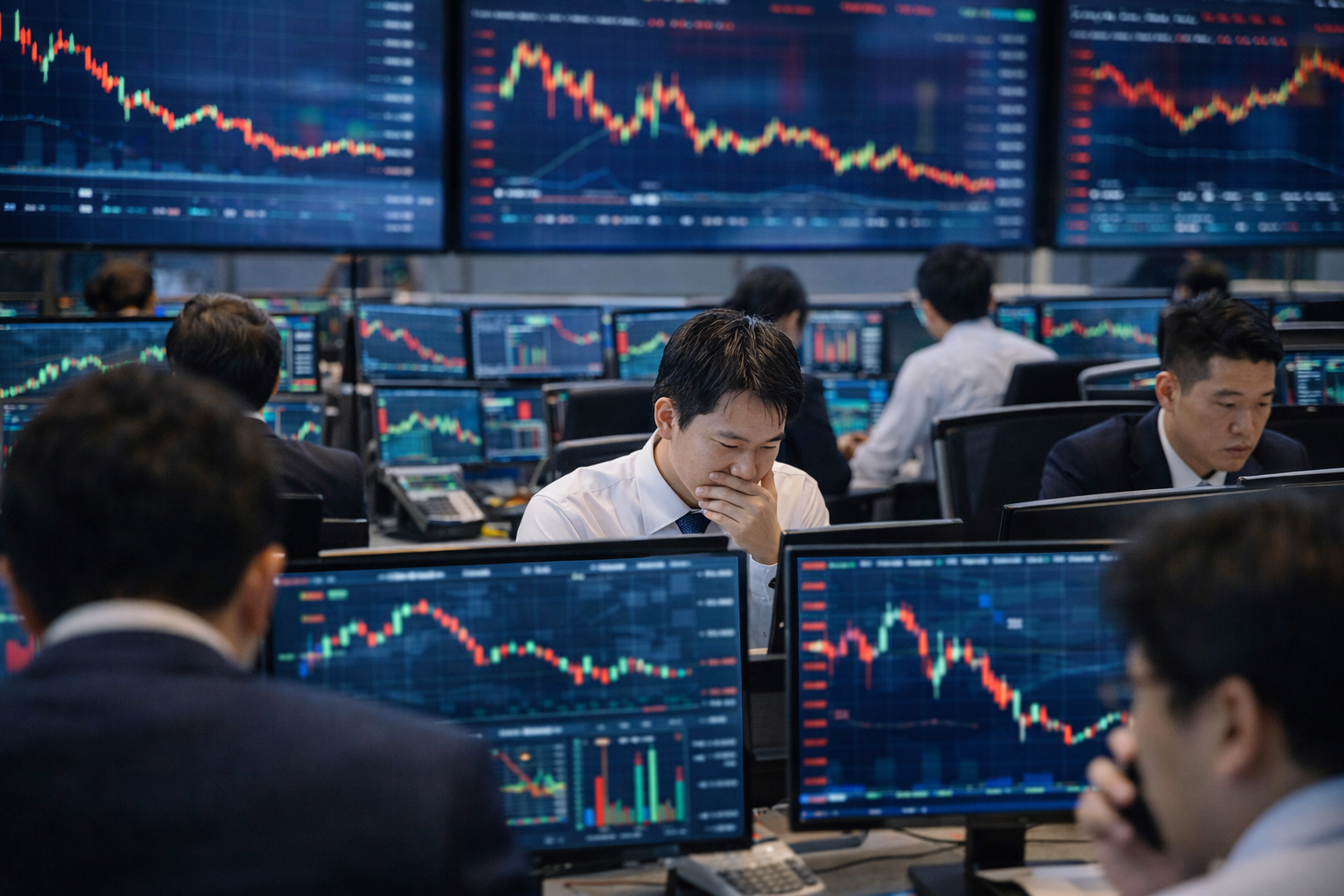
Asian stocks came under renewed pressure on Tuesday as rising oil prices and a global bond selloff pushed borrowing costs higher, but the damage was uneven across the region’s two major technology-heavy markets.
Japan’s Nikkei 225 fell about 1.2% to 65,070.58 in early trade, while South Korea’s KOSPI was down a much smaller 0.2% near 6,877 late in the morning.
The contrast reflected different starting points, as Japanese shares faced broad selling, while Samsung Electronics and SK Hynix rebounded after both dropped more than 5% on Monday.
The common threat was rates. The US 10-year Treasury yield briefly moved above 5.27% overnight, a 19-year high, while Brent crude traded around $106.60 a barrel as hopes for a quick US-Iran agreement remained limited.
Nikkei feels the full force of the bond selloff
The Nikkei’s weakness was broad, with 199 constituents falling and only 26 rising in early trade. The Topix lost about 1.8%, showing the pressure was not confined to a handful of expensive AI names.
Japan is particularly exposed to the latest rates move because domestic yields are climbing as well. The 10-year Japanese government bond yield rose to around 3.09% on Tuesday, near multi-decade highs.
Miki Den, senior Japan rates strategist at SMBC Nikko Securities noted that current yield levels could still support demand at a 40-year bond auction, although the broader move underlines how far Japan has travelled from its ultra-low-rate era.
Higher yields raise the discount rate applied to future earnings, making richly valued growth and technology shares harder to justify.
KOSPI gets a chip rebound after Monday’s rout
Seoul was more resilient after suffering the sharper shock a day earlier. The KOSPI had slumped 2.7% on Monday, with Samsung Electronics down 5.43% and SK Hynix down 5.05% as foreign and institutional investors sold heavily after the Chuseok break.
On Tuesday, Samsung gained about 1.5% and SK Hynix added 0.4%, helping offset losses in Hyundai Motor and LG Energy Solution.
Daishin Securities analyst Lee Kyung-min told The Korea Times that the sharp rise in US Treasury yields had already weakened risk appetite and overwhelmed some of the more positive geopolitical signals.
That pressure remains, but the rebound in Korea’s two largest chipmakers has prevented a repeat of Monday’s selloff.
Oil and higher policy rates squeeze the rest of Asia
Elsewhere, China’s CSI 300 remained close to a one-year low as technology sentiment stayed fragile following US plans to restrict Chinese components in data centres.
Australia’s market was little changed before the Reserve Bank of Australia raised its cash rate by 25 basis points to 4.6%, the highest since 2011, adding another sign that the region is entering a more restrictive rates environment.
The overnight lead from Wall Street was also weak. The Nasdaq fell 0.9% despite Nvidia expanding its share-buyback programme by $150 billion, while the S&P 500 lost about 0.8%.
Brent above $106 keeps the inflation problem alive at the same time as sovereign yields reset valuation benchmarks.