
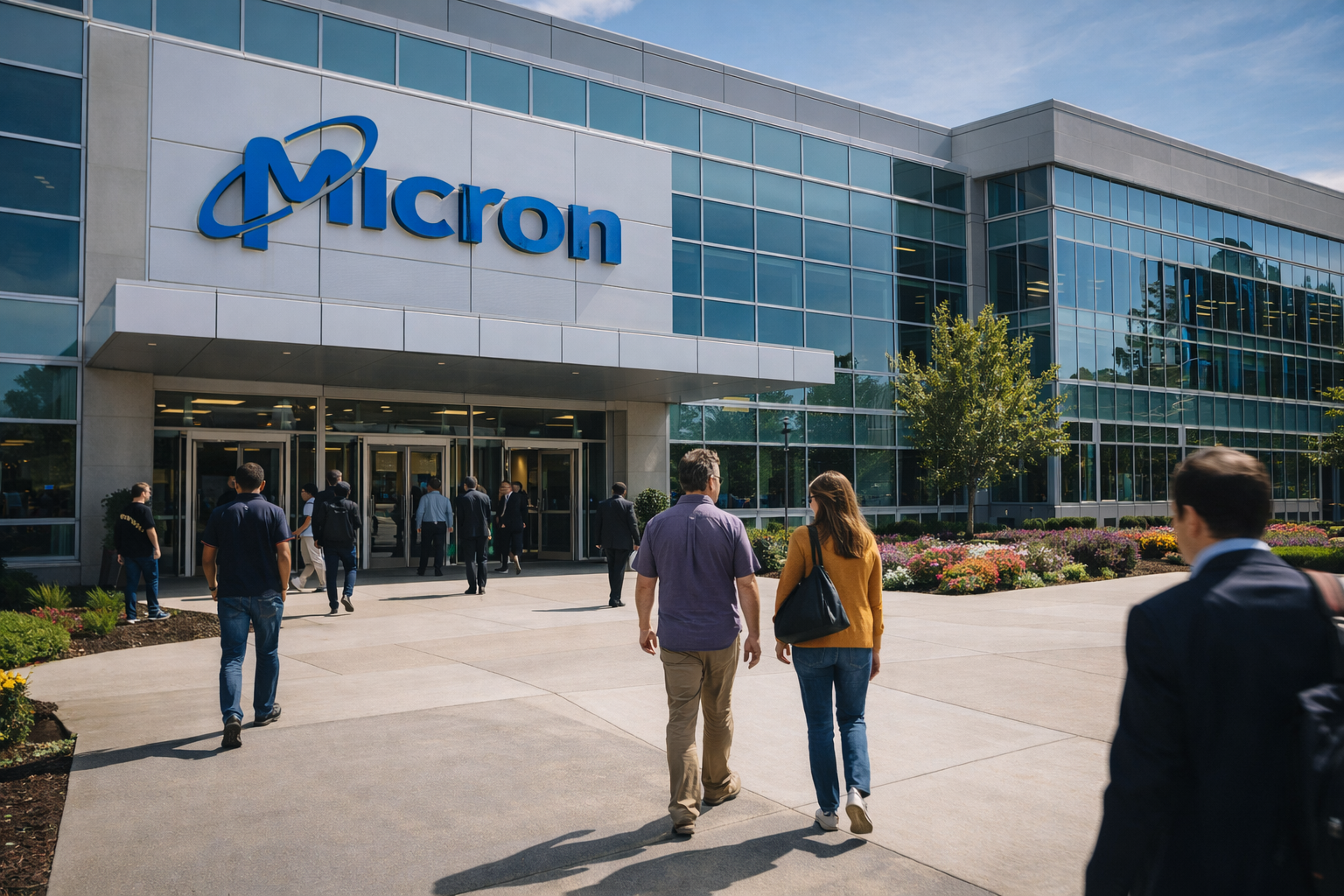
Micron stock (NASDAQ: MU) is back in focus after South Korea unveiled a massive semiconductor expansion led by Samsung Electronics and SK Hynix.
For now, the plan is less a direct threat to Micron than a validation of the theme behind its rally: AI memory has become scarce, valuable and strategically important.
But the harder question is, if Samsung and SK Hynix spend hundreds of billions of dollars on new DRAM and high-bandwidth memory capacity, could today’s shortage eventually turn into tomorrow’s supply problem?
Micron stock: Bull case still rests on memory scarcity
Micron’s latest results gave strong signals as the company delivered a blowout quarter, helped by AI demand, high-bandwidth memory shortages and strong pricing across the memory market.
More importantly, Micron showed that customers are no longer treating memory as a routine chip input.
They are trying to lock it in.
Micron has signed $22 billion in strategic customer commitments across data centre, consumer and automotive markets.
These agreements include take-or-pay terms, cash deposits and pricing floors.
In plain English, customers are committing ahead of time because they do not want memory supply to become the bottleneck that slows their AI buildouts.
Daniel Newman, CEO of Futurum Group, told Reuters that the scale of the AI buildout has been underestimated, and that memory should keep commanding “premium pricing” while supply remains constrained.
That is the core Micron bull case, as AI demand is running faster than supply, and MU is one of the few companies able to serve that market at scale.
But there is a catch. Analysts say Micron’s bull case still rests heavily on a tight memory market, and if fresh supply starts to return, pricing power could be the first part of the story to come under pressure.
Samsung and SK Hynix raise the supply stakes
South Korea’s new chip push is not aimed at Micron directly, but it changes the supply conversation.
Samsung Electronics and SK Hynix are preparing to invest 800 trillion won, or about $518 billion, in new chip fabrication sites as Seoul tries to cement the country’s lead in AI memory.
The wider plan is tied to President Lee Jae Myung’s industrial strategy, which aims to build semiconductor strength beyond existing hubs around Seoul.
For Samsung, the investment is partly a comeback strategy. The company remains one of the world’s biggest memory players, but SK Hynix and Micron have moved faster in high-bandwidth memory, the high-margin chip category used alongside AI processors.
The analysts at KB Securities-Jefferies noted that if Samsung qualifies successfully for next-generation HBM, the supplier structure could shift more toward SK Hynix and Samsung because of Samsung’s manufacturing capacity.
SK Hynix, meanwhile, is trying to defend the AI-memory crown it has built through Nvidia-linked HBM demand.
As per analysts, its customized AI memory has “fundamentally changed” industry economics and helped SK Hynix become the market leader.
What this means for Micron stock
For Micron investors, Korea’s $518 billion chip blitz is not an immediate sell signal.
As per experts, the new fabs will take years to build, and HBM qualification is difficult.
Customers do not switch suppliers overnight, and AI demand is still running ahead of available supply, which is why Micron has been able to secure long-term commitments and pricing protections in the first place.
The risk seems to be more about expectations.
Micron’s valuation has expanded because investors believe memory scarcity can last longer than in past cycles.
If Samsung and SK Hynix convince the market that a credible wave of new DRAM and HBM supply is coming after 2027, investors may start discounting weaker pricing power before the capacity actually arrives.